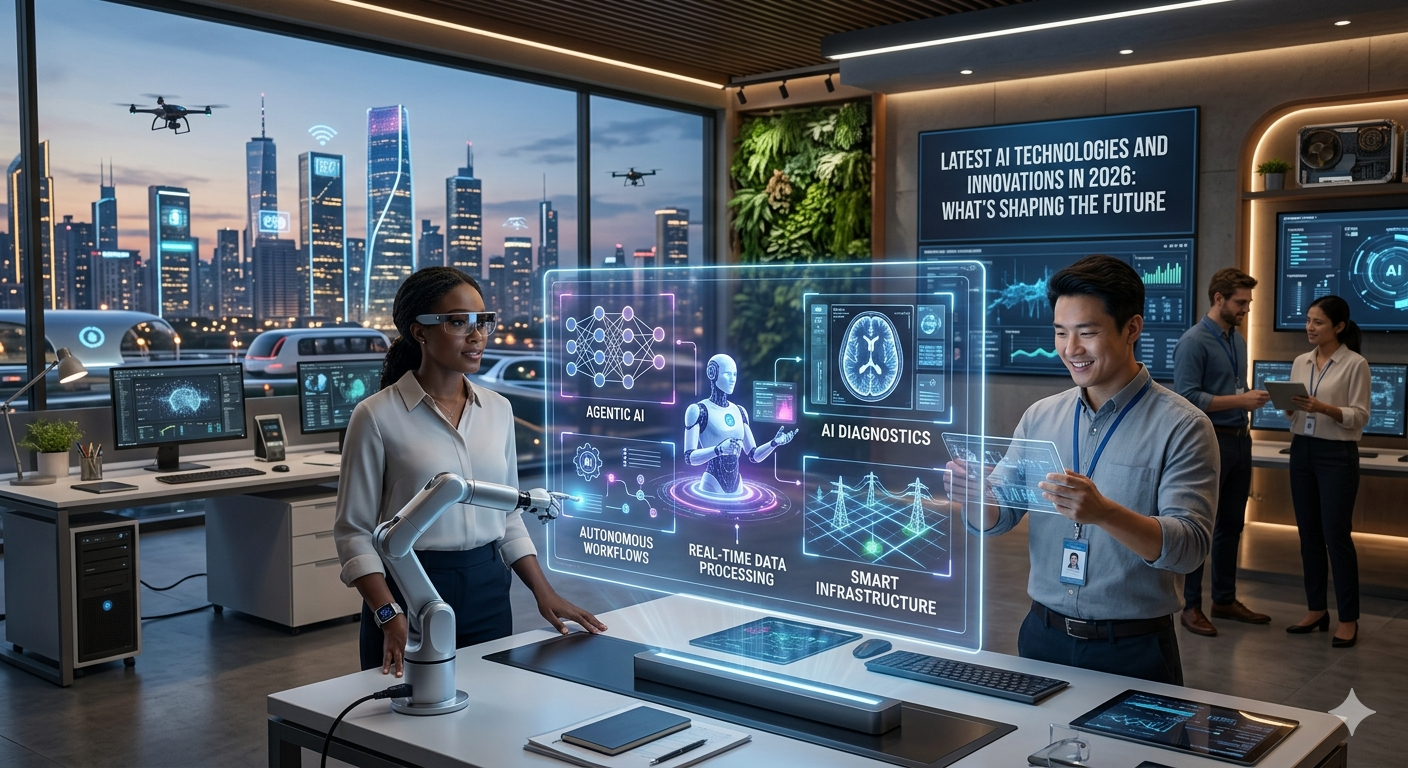
The latest AI technologies and innovations in 2026 are redefining industries, accelerating automation, and transforming how we live and work. From generative AI breakthroughs to ethical AI governance, this year marks a pivotal moment in artificial intelligence development. As machine learning models grow more sophisticated and accessible, businesses and individuals alike are witnessing unprecedented capabilities in real-time decision-making, creative content generation, and human-AI collaboration.
With advancements in neural architecture, multimodal AI systems, and edge computing, 2026 is shaping up to be a landmark year. These innovations aren’t just theoretical—they’re already being deployed in healthcare, finance, education, and smart cities. Let’s explore the most impactful AI technologies emerging this year and how they’re setting new standards across sectors.
Top AI Innovations Dominating 2026
1. Multimodal AI Systems
One of the most significant leaps in 2026 is the rise of multimodal AI—systems that process and understand multiple types of data simultaneously, such as text, images, audio, and video. Unlike earlier models limited to single data types, these AI platforms can interpret a doctor’s voice note, analyze an X-ray image, and generate a diagnostic report in seconds.
Table of Contents
- Top AI Innovations Dominating 2026
- 1. Multimodal AI Systems
- Table of Contents
- 2. AI-Powered Autonomous Agents
- 3. Generative AI for Scientific Discovery
- 4. Edge AI and On-Device Intelligence
- 5. Explainable AI (XAI) and Ethical Frameworks
- AI in Industry: Real-World Applications in 2026
- Challenges and Considerations
- Key Takeaways
- FAQ
- What are the most impactful AI technologies in 2026?
- How is AI improving decision-making in 2026?
- Is AI becoming more accessible to small businesses?
- Final Thoughts
Companies like OpenAI, Google DeepMind, and Anthropic have launched next-gen multimodal models capable of seamless cross-domain reasoning. This technology is revolutionizing customer service, medical diagnostics, and content creation by enabling more natural and context-aware interactions.
2. AI-Powered Autonomous Agents
Autonomous AI agents are no longer confined to research labs. In 2026, they’re actively managing workflows, scheduling meetings, negotiating contracts, and even conducting scientific experiments with minimal human oversight. These agents use reinforcement learning and real-time data analysis to adapt to dynamic environments.
For example, enterprise AI assistants now handle end-to-end project management—from drafting proposals to tracking deliverables. In manufacturing, robotic process automation (RPA) combined with AI agents is optimizing supply chains and reducing operational downtime by up to 40%.
3. Generative AI for Scientific Discovery
Generative AI has moved beyond text and images. In 2026, it’s accelerating drug discovery, materials science, and climate modeling. AI models can now simulate molecular interactions, predict protein folding with near-perfect accuracy, and design new materials with specific properties.
Pharmaceutical giants are using generative models to reduce drug development timelines from years to months. Similarly, climate scientists are leveraging AI to model complex environmental systems and predict extreme weather events with greater precision.
4. Edge AI and On-Device Intelligence
As privacy concerns grow, edge AI—where AI processing happens directly on devices like smartphones, wearables, and IoT sensors—is gaining momentum. In 2026, on-device AI models are faster, more secure, and energy-efficient, enabling real-time responses without relying on cloud servers.
This shift is critical for applications in autonomous vehicles, smart homes, and remote healthcare. For instance, AI-powered hearing aids now process speech and filter noise locally, ensuring user data never leaves the device.
5. Explainable AI (XAI) and Ethical Frameworks
With AI systems making high-stakes decisions, transparency is non-negotiable. The latest AI technologies in 2026 emphasize explainability, allowing users to understand how decisions are made. Regulatory bodies in the EU, U.S., and Asia have introduced stricter AI governance laws, mandating audit trails and bias detection.
New XAI tools visualize decision pathways, flag potential biases, and provide human-readable justifications. This builds trust and ensures compliance in sectors like finance, law enforcement, and hiring.
AI in Industry: Real-World Applications in 2026
The integration of AI across industries is no longer optional—it’s essential. Here’s how sectors are leveraging the latest innovations:
- Healthcare: AI diagnostics now match or exceed human radiologists in detecting early-stage cancers. Wearable AI monitors predict heart attacks hours in advance.
- Education: Personalized AI tutors adapt to individual learning styles, improving student outcomes by 30% in pilot programs.
- Finance: Fraud detection systems use behavioral AI to identify anomalies in real time, reducing false positives by 60%.
- Retail: AI-driven dynamic pricing and inventory management are boosting profitability while minimizing waste.
Challenges and Considerations
Despite rapid progress, challenges remain. Data privacy, algorithmic bias, and job displacement are ongoing concerns. In 2026, organizations are investing heavily in AI ethics training, diverse data sourcing, and reskilling programs to ensure responsible deployment.
Moreover, the environmental impact of training large AI models is under scrutiny. Green AI initiatives are promoting energy-efficient algorithms and renewable-powered data centers to reduce carbon footprints.
Key Takeaways
- The latest AI technologies and innovations in 2026 focus on multimodal intelligence, autonomy, and ethical transparency.
- Generative AI is accelerating scientific breakthroughs, while edge AI enhances privacy and speed.
- Industries from healthcare to finance are achieving measurable gains through AI integration.
- Explainable AI and regulatory compliance are now central to responsible AI development.
FAQ
What are the most impactful AI technologies in 2026?
The most impactful include multimodal AI systems, autonomous agents, generative AI for science, edge AI, and explainable AI frameworks. These are driving innovation across healthcare, education, and enterprise operations.
How is AI improving decision-making in 2026?
AI enhances decision-making by processing vast datasets in real time, identifying patterns, and providing actionable insights. With explainable AI, users can trust and verify outcomes, especially in high-stakes fields like medicine and finance.
Is AI becoming more accessible to small businesses?
Yes. Cloud-based AI platforms, open-source models, and no-code AI tools are making advanced technologies affordable and user-friendly. Small businesses can now deploy AI for customer service, marketing, and operations without large IT teams.
Final Thoughts
The latest AI technologies and innovations in 2026 are not just advancing capabilities—they’re reshaping societal norms and economic structures. As AI becomes more integrated into daily life, the focus must remain on ethical development, inclusivity, and sustainability. The future isn’t just intelligent—it’s responsible.
Stay ahead of the curve by monitoring these trends and exploring how AI can solve real-world problems in your field. The age of intelligent transformation is here—and it’s only getting started.