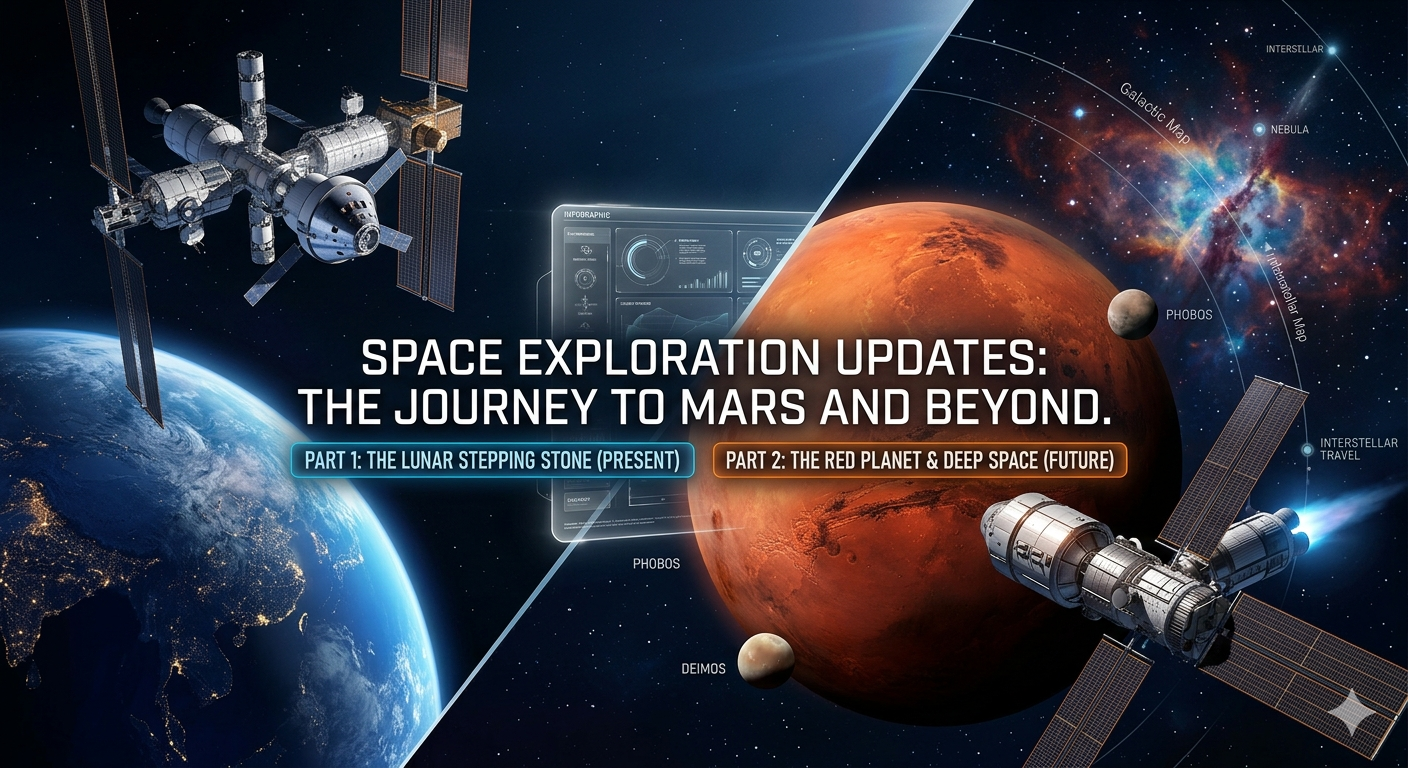
The dream of reaching Mars is no longer science fiction—it’s becoming a tangible reality. Recent space exploration updates reveal unprecedented progress in humanity’s quest to land on the Red Planet and venture even farther into the cosmos. With NASA, SpaceX, and international partners accelerating missions, the journey to Mars and beyond is unfolding faster than ever before.
From advanced propulsion systems to life-support technologies, every breakthrough brings us closer to establishing a sustainable human presence off Earth. This article dives into the latest developments, challenges, and future milestones shaping this bold new era of interplanetary travel.
Recent Milestones in Mars Exploration
2023 and 2024 have been landmark years for Mars missions. NASA’s Perseverance rover continues to collect rock samples that may hold clues to ancient microbial life. Meanwhile, the Ingenuity helicopter has completed over 70 flights, proving that powered flight is possible in Mars’ thin atmosphere.
SpaceX’s Starship, designed for deep-space travel, has undergone multiple test flights with increasing success. The fully reusable spacecraft aims to carry astronauts and cargo to Mars within the next decade. Elon Musk’s vision of a self-sustaining Martian city is no longer a distant fantasy—it’s a strategic roadmap.
Table of Contents
- Recent Milestones in Mars Exploration
- Table of Contents
- Technological Innovations Driving the Mission
- Advanced Propulsion Systems
- Life Support and Habitat Solutions
- Radiation Protection
- The Role of International Collaboration
- Challenges on the Road to Mars
- Beyond Mars: The Next Frontier
- Key Takeaways
- FAQ
- When will humans land on Mars?
- How long does it take to get to Mars?
- Can we live on Mars permanently?
- NASA’s Artemis program is paving the way for lunar bases, serving as a testing ground for Mars technologies.
- China’s Tianwen-1 mission successfully deployed a rover on Mars, marking a major achievement for international space collaboration.
- Private companies like Rocket Lab and Relativity Space are developing smaller, cost-effective launch systems to support Mars logistics.
Technological Innovations Driving the Mission
Advanced Propulsion Systems
Traditional chemical rockets are too slow and inefficient for frequent Mars trips. New propulsion technologies, such as nuclear thermal propulsion (NTP) and solar electric propulsion, are being tested to cut travel time from months to weeks.
NASA’s DRACO project aims to demonstrate a nuclear-powered engine by 2027. This could revolutionize deep-space travel, enabling faster, safer journeys to Mars and beyond.
Life Support and Habitat Solutions
Surviving on Mars requires more than just a spacesuit. Engineers are developing closed-loop life support systems that recycle air, water, and waste. Inflatable habitats, like those from Bigelow Aerospace, offer lightweight, expandable living spaces.
3D printing using Martian regolith (soil) is also being tested to build shelters on-site, reducing the need to transport heavy materials from Earth.
Radiation Protection
One of the biggest threats to astronauts is cosmic radiation. Mars lacks a magnetic field and thick atmosphere, exposing travelers to harmful solar and galactic radiation.
Researchers are exploring water-filled walls, magnetic shielding, and pharmaceutical countermeasures to protect crew health during long-duration missions.
The Role of International Collaboration
Space exploration is no longer a solo endeavor. The European Space Agency (ESA), Japan’s JAXA, and the UAE’s Mohammed bin Rashid Space Centre are all contributing to Mars research.
The International Mars Exploration Working Group (IMEWG) coordinates global efforts, sharing data and resources to avoid duplication and maximize success. This collaborative spirit is essential for tackling the immense challenges of interplanetary travel.
Joint missions, such as the Mars Sample Return campaign between NASA and ESA, highlight how cooperation accelerates progress. Samples collected by Perseverance will be retrieved and returned to Earth by the early 2030s—a complex mission requiring precision and trust across nations.
Challenges on the Road to Mars
Despite rapid advancements, significant hurdles remain. The psychological effects of long-term isolation, limited medical resources, and the high cost of missions pose serious risks.
Launch windows to Mars occur only every 26 months, when Earth and Mars are optimally aligned. Missing a window delays missions by over two years, increasing financial and logistical strain.
Moreover, ethical questions arise: Should we terraform Mars? What rights do future Martian settlers have? These debates are just beginning.
Beyond Mars: The Next Frontier
While Mars is the immediate target, visionaries are already looking further. Jupiter’s moon Europa and Saturn’s Enceladus harbor subsurface oceans that may host life.
NASA’s Europa Clipper mission, launching in 2024, will study the moon’s icy shell and potential habitability. Robotic probes could one day drill through the ice to explore these alien seas.
Long-term, interstellar travel remains the ultimate goal. Concepts like laser-propelled light sails and antimatter engines are being studied, though they remain decades away from practical use.
Key Takeaways
- The journey to Mars is accelerating, with major missions and technological breakthroughs happening now.
- NASA, SpaceX, and international partners are leading the charge with reusable rockets, advanced habitats, and nuclear propulsion research.
- Surviving on Mars requires solving challenges like radiation, life support, and psychological health.
- Collaboration across nations and industries is critical to success.
- Beyond Mars, moons like Europa and Enceladus offer exciting possibilities for discovering extraterrestrial life.
FAQ
When will humans land on Mars?
NASA aims to send astronauts to Mars in the late 2030s, while SpaceX targets the 2030s as well. The exact timeline depends on technological readiness, funding, and successful testing of spacecraft and life-support systems.
How long does it take to get to Mars?
Travel time varies based on planetary alignment, but typically ranges from 6 to 9 months using current propulsion methods. Future nuclear or electric propulsion could reduce this to 3–4 months.
Can we live on Mars permanently?
With advanced habitats, in-situ resource utilization (like extracting water from ice), and sustainable energy (such as solar or nuclear), long-term human settlement is feasible—but it will require decades of preparation and innovation.
Image suggestion: A conceptual illustration of a Mars base with solar panels, greenhouses, and astronauts walking near a Starship vehicle under a pink Martian sky.
The journey to Mars and beyond is no longer a distant dream—it’s a mission in motion. With each rocket launch, rover landing, and scientific discovery, humanity takes another step toward becoming a multi-planetary species.